
❄️ Types of Wool Slippers: A B2B Sourcing Guide
When building a profitable winter footwear collection, the most critical question sourcing managers must answer is: what types of wool slippers should we manufacture?
🐑 The Value of Wool
Wool is universally recognized as a premium, sustainable material, celebrated for its natural thermoregulation and moisture-wicking properties.
⚠️ The Danger of Vague Specifications
However, simply asking a factory for a “wool slipper” is a recipe for disaster. You must specify the exact structural design, the sole compound, and the target user.
🎯 Engineering for the Consumer
The different types of wool slippers are engineered to solve specific consumer pain points. An open-back design offers unmatched convenience for a busy professional, while a full-heel bootie offers the safety and warmth required by a toddler or an elderly user.
🚀 Structuring for Retail Success
In this ultimate B2B sourcing guide, we will break down the main categories, evaluate their manufacturing specifications, and provide actionable advice on how to structure your Purchase Orders (POs) for maximum retail success.
🔍 Exploring the Main Categories of Wool Indoor Footwear
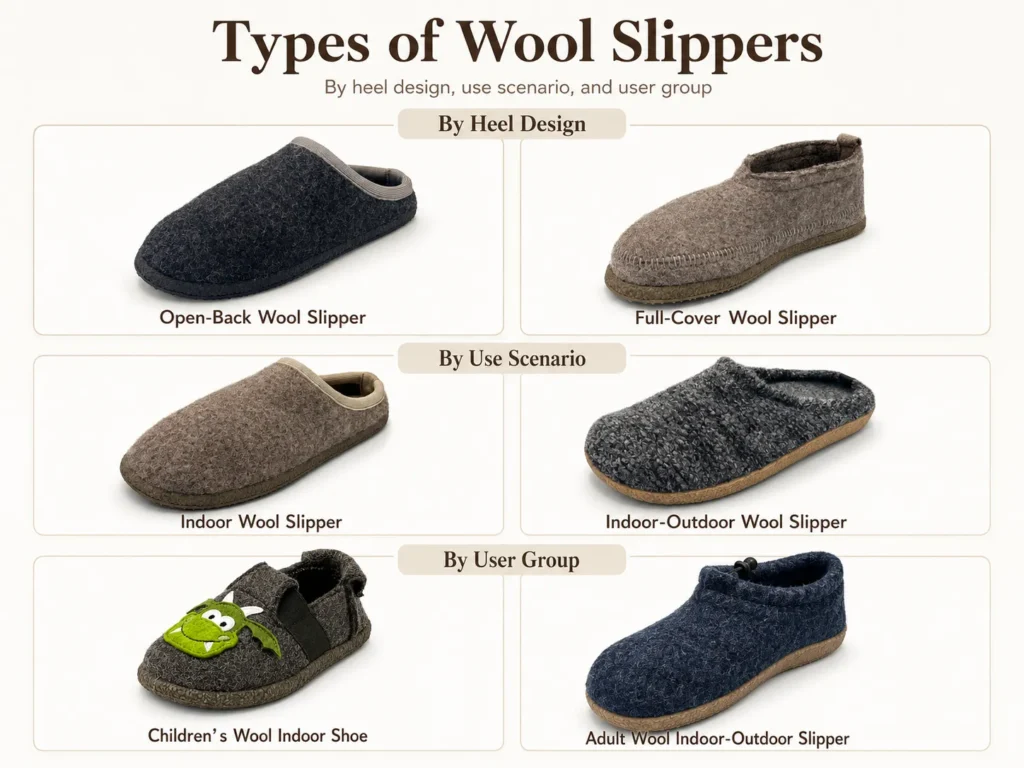
Before you request physical samples from an overseas manufacturer, you must outline the overarching strategy of your footwear collection. We categorize wool slipper types based on three primary dimensions: heel design, usage scenario (sole), and the target demographic.
👠 Wool Slippers by Heel Design
The heel structure is the architectural foundation of a slipper, dictating both the ease of wear and the level of secure fit on the foot.
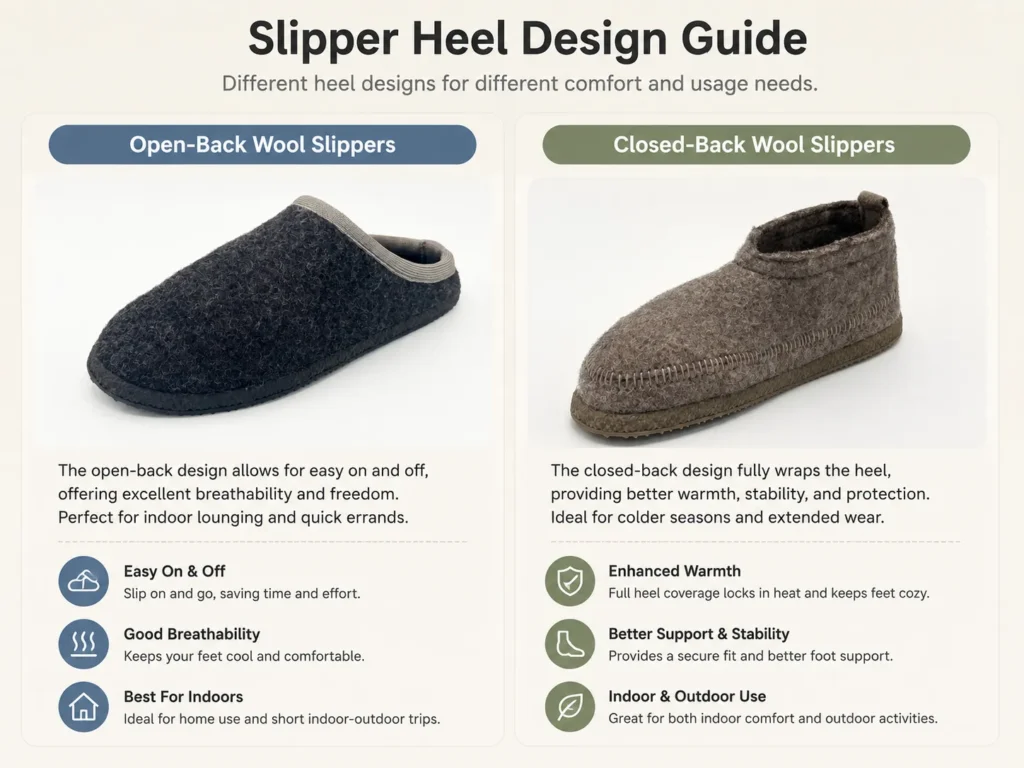
🩴 Open-Back Wool Slippers (Scuffs)
These backless designs allow the wearer to effortlessly slide their foot in and out without bending down. They prioritize casual convenience and maximum breathability for the heel.
👞 Full-Heel Wool Slippers (Closed-Back)
These styles feature a structured rear counter that entirely encloses the heel. They lock the foot in place, providing superior walking stability and sealing out cold drafts.
💡 Strategic Insight: Ultimately, choosing the right heel design balances the trade-off between quick convenience and structural security. For factories, open-back designs reduce stitching time and material costs, while full-heel designs justify a higher premium retail price point due to their complex, supportive construction.
🛣️ Wool Slippers by Usage Scenario
A slipper’s sole determines its environment, defining whether the footwear belongs strictly on a bedroom rug or can handle a quick trip to the driveway.
🏠 Indoor Wool Slippers
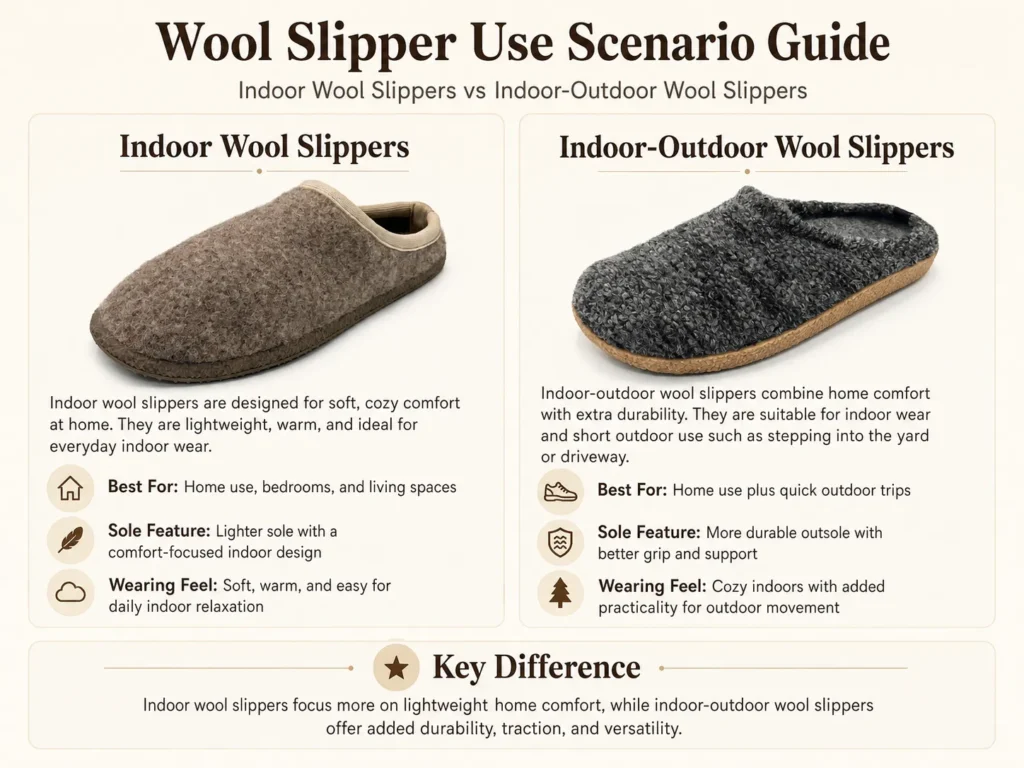
Equipped with soft bottoms like faux suede, felt, or thin EVA, these slippers are whisper-quiet and designed to protect delicate hardwood floors from scratches. They are extremely lightweight and highly flexible.
🌲 Indoor-Outdoor Wool Slippers
Built with rugged, injected TPR or heavy-duty rubber outsoles, these hybrids bridge the gap between a house shoe and a street shoe. They feature aggressive tread patterns to grip wet surfaces and resist concrete abrasion.
💡 Strategic Insight: Sourcing the correct sole scenario is vital for customer satisfaction. An indoor sole provides the ultimate lightweight “home” feeling, while the indoor-outdoor sole caters to active consumers who demand rugged versatility from their winter homewear. Wool is widely used in indoor footwear because it offers warmth, comfort, and moisture management. According to The Woolmark Company, natural wool can absorb moisture and help manage odor, making it the perfect upper to pair with these diverse sole scenarios.
👥 Wool Slippers by Target User
The demographic profile of the end-user drastically shifts the engineering, safety, and aesthetic requirements of the footwear.
🧸 Children’s Wool Indoor Shoes
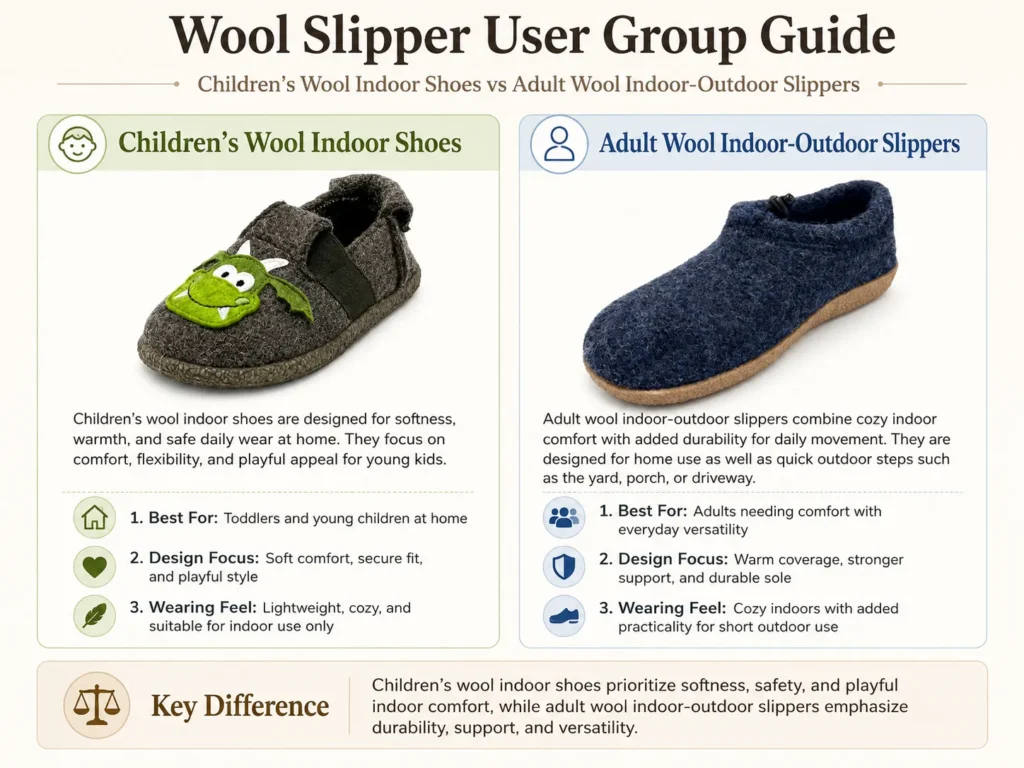
Engineered with strict safety protocols, these feature secure full-heel wrappings, elastic ankle bands, and high-friction soles to prevent slipping during active play. They also require non-toxic, skin-safe dyed wool.
👩💼 Adult Wool Slippers
Designed with a focus on lifestyle and ergonomics, these styles range from minimalist slip-ons to elaborate booties. They often incorporate high-density memory foam to relieve foot fatigue and cater to diverse aesthetic preferences.
💡 Strategic Insight: Segmenting by target user ensures your tech packs are accurate. While adult lines allow for creative freedom and diverse heel structures, pediatric lines must prioritize uncompromising physical safety and secure, stable constructions above all else.
📐 Wool Slippers by Heel Construction
Let us dive deeper into the physical construction of the heel, which is often the primary deciding factor for consumers browsing retail shelves.
🩴 Open-Back Wool Slippers
Open-back wool slippers are designed without a closed heel, making them exceptionally easy to slip on and off without bending down or using hands. From a manufacturing perspective, these are highly efficient to produce. The factory does not need to build a rigid heel counter, which reduces assembly time and material costs. They are mainly used for adult homewear, hotel use, winter retail collections, and casual indoor comfort where the wearer transitions frequently from sitting to walking.
🛒 Best Markets for Open-Back Wool Slippers
Because the sizing is highly forgiving (a slight heel overhang is acceptable to most consumers), this style is perfect for volume-driven retail. The best markets include:
- Adult Homewear Brands: Targeting the work-from-home professional.
- Supermarkets & Big Box Stores: Ideal for impulse-buy aisles due to lower production costs.
- Hotel Suppliers: Luxury resorts prefer slip-ons for guest amenities.
- Gift Set Brands: A safe, easily giftable item during Q4 holidays.
- E-commerce Sellers: Fewer sizing-related returns protect online profit margins.
🥾 Full-Heel Wool Slippers
Conversely, full-heel wool slippers cover the heel area completely, wrapping the foot in a secure microclimate. This design provides significantly better warmth, preventing cold drafts from hitting the Achilles tendon. It also ensures foot wrapping and wearing stability. This structure is suitable for both adults and children, but it is especially important for children’s indoor shoes where tripping hazards must be mitigated.
🛍️ Best Markets for Full-Heel Wool Slippers
This silhouette demands a higher retail price point due to its complex construction and premium feel. Target markets include:
- Winter Homewear Collections: Positioned as heavy-duty winter gear.
- Children’s Indoor Footwear: Where safety and secure fits are non-negotiable.
- Premium Retail Lines: Boutique brands targeting older demographics who require structural foot support.
- Colder Markets: Consumers in Canada, Northern Europe, and the Northern US.
🛣️ Wool Slippers by Usage Scenario (Sole Variations)
If the heel design dictates comfort, the outsole dictates utility. Brand sourcing managers must match the sole compound precisely to the consumer’s lifestyle.
🏠 Indoor Wool Slippers
Indoor wool slippers are strictly and intentionally designed for home, bedroom, hotel rooms, offices, and other highly controlled indoor environments. The primary goal of this sole is to protect the flooring and the foot simultaneously. Therefore, the sole is usually softer, lighter, and far more flexible than outdoor shoes.
✨ Sole Features for Indoor Wool Slippers
When writing your spec sheet, describe a soft sole structure made from high-density EVA, genuine suede, or thick wool felt. These materials provide a lightweight feel, enabling comfortable walking and completely quiet indoor movement. They offer better flexibility for home use, allowing the user to curl their feet on the sofa without feeling a rigid rubber board beneath them.
💡 Industry Standard: According to ISO 17707:2005, outsole flex resistance is an important way to evaluate how a sole performs under repeated bending. For wool slippers, this is useful when comparing soft indoor soles with stronger indoor-outdoor soles, because both comfort and flex performance affect daily wear.
🌲 Indoor-Outdoor Wool Slippers
Modern consumers demand versatility. Indoor-outdoor wool slippers are made for indoor wear and short outdoor use, such as walking to the balcony, garden, mailbox, courtyard, or taking a short walk outside. This hybrid requirement means the sole must act like a real shoe while maintaining the aesthetic of a slipper.
🥾 Sole Features for Indoor-Outdoor Wool Slippers
For this category, your PO must describe thicker soles (typically 15mm to 25mm of injected TPR or rubber). These soles offer better abrasion resistance against concrete, improved grip on wet driveways, stronger arch support, and a much more durable bottom construction.
🏭 Factory Experience: Why Indoor-Outdoor Wool Slippers Need Stronger Soles
For one adult wool slipper project, the buyer wanted the same style for indoor wear and short outdoor use. During sole testing, we found that a light indoor sole felt comfortable at home but was not durable enough for rough outdoor surfaces. So we changed to a thicker, more wear-resistant sole with better grip, which is why we separate indoor wool slippers from indoor-outdoor wool slippers by sole structure, not only by appearance.
👥 Wool Slippers by Target User Demographics
A B2B buyer cannot use the exact same tech pack for a toddler and a 40-year-old adult. The target user fundamentally changes the engineering requirements.
🧸 Children’s Wool Indoor Shoes
Children’s footwear is a highly specialized niche. Children’s wool indoor shoes are usually made with a full-heel design because children need better foot wrapping and stability during indoor movement. A child running across a polished wooden floor in a backless scuff is highly likely to trip or twist an ankle.
✨ Key Features of Children’s Wool Indoor Shoes
When sourcing for kids, mention the absolute necessity of a full-heel structure, often reinforced with an elastic ankle collar. While the sole must be anti-slip, it should maintain a soft sole, lightweight construction to not hinder natural foot development. A warm upper material, flexible movement, and non-toxic indoor comfort are the core pillars of pediatric footwear.
🏭 Factory Experience: Why Children’s Wool Slippers Use Full-Heel Design
In our factory sampling process, some buyers asked whether children’s wool slippers could be made in an open-back style to reduce cost. After fitting checks, we found that the heel slipped off more easily when children walked quickly or moved around indoors. Based on this experience, we recommend full-heel construction for children’s wool indoor shoes because it gives better foot wrapping and stability.
👩💼 Adult Wool Slippers
In contrast, adult wool slippers can be developed in widely different structures, including both open-back and full-heel designs. Because adults possess controlled motor skills, they prioritize convenience and aesthetics over raw safety. Furthermore, adult slippers can also be made for indoor use or indoor-outdoor use depending on the sole, offering massive variety for product line planners.
✨ Key Features of Adult Wool Slippers
For adult B2B sourcing, mention the focus on ergonomic comfort (using 45D high-density memory foam), extreme warmth, easy wearing convenience, style variety, diverse sole options, and wider use scenarios for retail buyers.
🛒 How to Choose the Right Wool Slipper Type for Your Product Line
🏭 Industry Case: What Glerups Shows About Wool Slipper Type Development
Glerups is a well-known wool slipper brand that separates its products by sole type, including leather soles and natural rubber soles. This shows that wool slipper types are not decided only by the upper material. For B2B buyers, heel design, sole structure, target user, and wearing scenario should all be considered before developing a wool slipper collection.
With that in mind, how do you practically build your PO? Here is your strategic decision matrix.
🩴 Choose Open-Back Wool Slippers for Easy Daily Use
Explain to your merchandising team that this type is suitable for adult indoor use, hotel programs, supermarkets, and entry-level winter collections.
📋 Step-by-Step PO Guide:
- Specify “Backless Scuff Design.”
- Request a 10mm EVA sole to keep freight costs low.
- Order standard size groupings (e.g., S, M, L) rather than exact numerical sizes to minimize SKU bloat.
🥾 Choose Full-Heel Wool Slippers for Better Warmth and Stability
Explain that this type is highly suitable for children, colder geographic markets, premium winter homewear collections, and buyers who want better foot coverage.
📋 Step-by-Step PO Guide:
- Specify “Closed-Back Design with Internal Heel Counter.”
- Request exact numerical sizing (e.g., US 8, EU 41) to ensure the heel cup fits snugly without causing blisters.
🏠 Choose Indoor Wool Slippers for Home and Hotel Use
Explain that indoor soles are better for comfort, flexibility, lightweight feel, and controlled indoor environments.
📋 Step-by-Step PO Guide:
- Specify “Non-marking Indoor Sole.”
- Choose a faux suede or felt bottom with silicone anti-slip dots.
- Highlight that the product must be silent on hard floors.
🌲 Choose Indoor-Outdoor Wool Slippers for More Versatile Use
Explain that indoor-outdoor soles are better for buyers who want stronger durability, better grip, and short outdoor use.
📋 Step-by-Step PO Guide:
- Specify “Injected TPR Outsole.”
- Request a sole thickness of at least 15mm.
- Demand a deep, aggressive tread pattern to handle wet outdoor surfaces.
📊 Wool Slipper Type Comparison
To help buyers compare different wool slipper types more clearly, the table below summarizes the main differences by heel design, sole structure, target user, and product development direction.
🩴 Open-Back vs Full-Heel Wool Slippers
💡 Summary: Choosing between an open-back or full-heel design ultimately balances convenience with security. Open-back styles are ideal for fast-moving volume retail, while full-heel designs cater to premium stability and warmth.
👉 Click here to read our full guide on Open-Back vs Full-Heel Wool Slippers.
🛣️ Indoor vs Indoor-Outdoor Wool Slippers
For slippers designed for short outdoor use, grip should also be considered. ASTM F2913 provides a method for measuring the dynamic coefficient of friction between footwear and flooring, which helps explain why outsole material, tread pattern, and contact surface are important for indoor-outdoor wool slippers.
💡 Summary: The sole compound dictates the shoe’s utility. Indoor soles prioritize lightweight, quiet comfort, whereas indoor-outdoor hybrids demand durable, slip-resistant materials to bridge the gap between home and the driveway.
👉 Click here to read our full guide on Indoor vs Indoor-Outdoor Wool Slippers.
👨👩👧👦 Children’s vs Adult Wool Slippers
💡 Summary: Target demographics drastically alter engineering priorities. Children’s footwear requires strict safety, secure fits, and non-toxic materials, whereas adult lines allow for diverse styling and varied lifestyle applications.
👉 Click here to read our full guide on Children’s vs Adult Wool Slippers.
🛠️ Custom Options for Different Wool Slipper Types
The core advantage of private label wool slippers is OEM/ODM customization. You can manipulate the following specs to align with your brand.
🧵 Upper Material Options
Explain to your factory what you need: pure Merino wool for ultra-luxury, a 50/50 wool blend for a balance of durability and cost, or boiled/felted wool for a structured, minimalist Scandinavian aesthetic. Detail the different surface textures you desire, such as a knitted sweater look versus a smooth felt finish.
🥾 Sole Material Options
Explain your choice between indoor soft soles (suede, EVA, felt) and indoor-outdoor durable soles (TPR, Rubber, PU). Remember to request physical lab testing for flex resistance and slip coefficients based on your choice.
🎨 Color, Logo, and Packaging Options
Mention custom Pantone colors for the wool dyes. For branding, specify high-density embroidery on the upper, elegant woven labels stitched to the footbed, or debossed logos on the rubber sole. Finally, elevate the unboxing experience with custom hangtags, moisture-proof polybags, branded retail boxes, and premium gift packaging tailored for Q4 retail collections.
🎯 Conclusion
🔑 The Key to a Profitable Collection
Mastering the different types of wool slippers is the key to building a cohesive, profitable, and highly targeted footwear collection.
💡 Market Dissection: By dissecting the market into clear dimensions—analyzing the functional differences between open-back scuffs and full-heel designs, and matching soft indoor soles or rugged indoor-outdoor TPR to the correct consumer environment—you eliminate the guesswork from your sourcing strategy.
🚀 Master Your Sourcing Strategy
Whether you are designing ultra-secure indoor booties for children or luxurious, memory-foam-lined scuffs for adult homewear lines, the specifications you draft today will dictate your customer reviews tomorrow.
⭐ Actionable Advice: Leverage the structural insights and customization standards outlined in this ultimate guide to negotiate confidently with your manufacturing partners and dominate the winter retail market.
❓ FAQ About Types of Wool Slippers
🗂️ What are the main types of wool slippers?
The main types are categorized by heel design (open-back scuffs vs. full-heel closed shoes) and by sole functionality (soft indoor soles vs. durable indoor-outdoor TPR soles).
⚖️ Are open-back wool slippers or full-heel wool slippers better?
Neither is inherently better; it depends on the end-user. Open-back slippers offer superior convenience for sliding on and off, while full-heel slippers provide superior warmth and walking stability.
🧸 Are children’s wool slippers always full-heel?
Yes, almost universally. Due to children’s active movements, a full-heel design is critical to prevent the slipper from falling off and causing tripping hazards.
🛣️ What is the difference between indoor and indoor-outdoor wool slippers?
The difference is the outsole. Indoor wool slippers use soft, flexible materials like suede or thin EVA. Indoor-outdoor slippers use thick, rugged TPR or rubber to withstand concrete and wet surfaces.
🛍️ What type of wool slippers is best for adult retail collections?
A well-rounded adult retail collection should offer both. However, an open-back wool slipper with an indoor-outdoor TPR sole is often the highest-selling hybrid, offering both convenience and rugged utility.
🏷️ Can wool slippers be customized for private label orders?
Absolutely. B2B buyers can customize wool slippers by specifying exact wool blends, custom Pantone colors, bespoke sole molds, embroidered logos, and branded retail packaging.